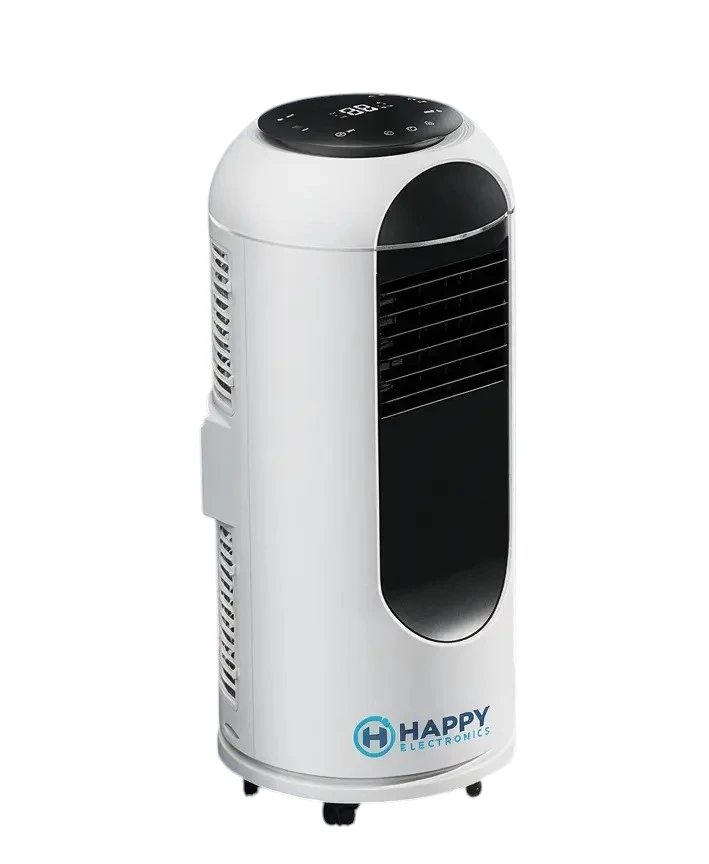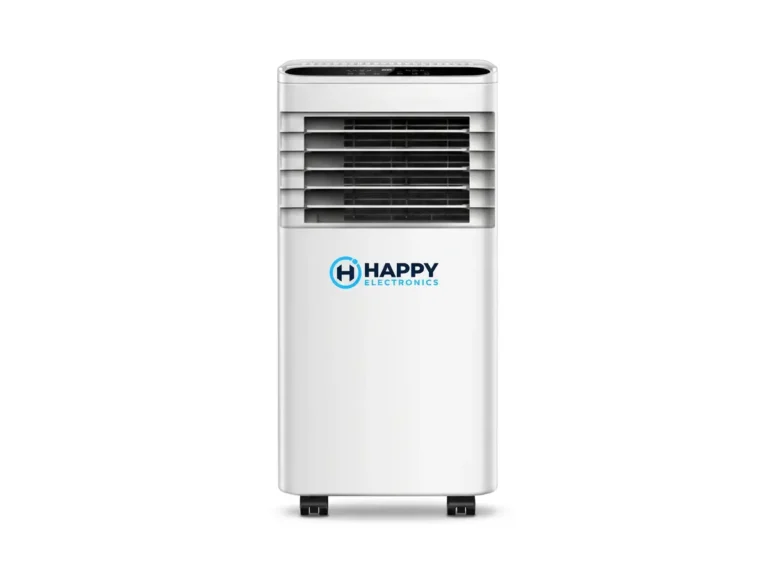

An air conditioner removes heat and moisture from your room and pumps the heat outside through a hose. An air cooler is a fan that blows air across water: it does not remove any heat from the room, and it adds moisture. In a humid UK summer, that means an air cooler can cool you down when you sit in front of it, but it rarely lowers the temperature of the room. An air conditioner does.
How an air conditioner works
A portable air conditioner uses a refrigerant (our units use R290) to pull heat out of the air in your room. That heat is pushed outside through an exhaust hose fitted to a window. As the air cools, moisture comes out of it too, so the room feels cooler and less sticky.
The key point: the heat leaves the room. That is why every real portable air conditioner has an exhaust hose.
How an air cooler works
An air cooler, also called an evaporative cooler, has a water tank and a fan. The fan pulls air through wet pads or past ice packs. As the water evaporates, the air coming out feels cooler.
But the heat is not removed from the room, and the evaporating water makes the air more humid. Air coolers work best in hot, dry air. One UK retailer advises they work best above 25°C with humidity below 60%, and in a well-ventilated space (National Heater Shops).
Why this matters in the UK
UK summers are often humid, especially during heatwaves and on warm nights. Because air coolers add moisture, they are far less effective in humid conditions like ours (Homebuilding & Renovating). In practice, an air cooler helps most when the air blows directly on you, rather than cooling the whole room.
Air cooler vs air conditioner at a glance
| Portable air conditioner | Air cooler | |
|---|---|---|
| Lowers the room temperature | Yes | Only slightly; mainly cools you in the airflow |
| Humidity | Removes moisture | Adds moisture |
| Power use | For example 580 W (our Comfort 9K) | Typically 50 to 300 W |
| Running cost per hour* | About 15p | About 1p to 8p |
| Needs a window | Yes, for the exhaust hose | Ventilation recommended |
| Works in humid weather | Yes | Poorly |
| Best for | Bedrooms, home offices, heatwaves | A personal breeze on dry days |
*At the Ofgem price cap of 26.32p per kWh (1 October to 31 December 2026), running at full power.
Watch out for “mini air conditioners”
Many small units sold as “mini”, “personal” or “no-window” air conditioners are actually air coolers. A simple test: if it has no exhaust hose, it is not removing heat from the room. Check for a hose before you buy.
Which should you buy?
- Choose an air conditioner if you need to sleep or work in a hot room, especially on humid nights. Our Comfort 9K is a quiet 9,000 BTU option for bedrooms and home offices.
- Choose an air cooler or a fan if you only want a cool breeze at your desk on dry days and want the lowest running cost.
Not sure what size you need? Read our BTU size guide, browse our portable air conditioners, or ask our team for free advice.
Frequently asked questions
Can an air cooler replace an air conditioner?
Not in a typical UK summer. An air cooler can make you feel cooler in its airflow, but it cannot remove heat from the room the way an air conditioner does.
Does an air conditioner need water?
No. You never fill an air conditioner with water. It removes moisture from the air as it cools, and depending on the model, that water is collected or evaporated.
Are air coolers good for bedrooms?
They can make a stuffy bedroom feel more humid, especially with the window closed. For sleeping on hot nights, an air conditioner usually works much better. Our heatwave guide has more ideas for keeping bedrooms cool.
Are air coolers cheaper to run?
Yes, much cheaper, because they only run a fan and a small pump. The trade-off is that they do far less cooling.
Sources: Homebuilding & Renovating, air conditioner vs air cooler; National Heater Shops, how evaporative coolers work; Ofgem, price cap October to December 2026.